
What Does Resetting a Circuit Breaker Actually Mean?
Knowing how to reset a circuit breaker in your house is one of the most practical electrical skills a Melbourne homeowner can have. When a breaker trips, it cuts power to a circuit to prevent overheating or electrical damage. Resetting it simply means switching it back to the ‘on’ position — but only after you’ve identified and addressed the cause of the trip.
It sounds straightforward, but doing it incorrectly — or at the wrong time — can create a genuine safety hazard. This guide walks you through the process step by step, so you can handle it with confidence.
Why Do Circuit Breakers Trip in Melbourne Homes?
Circuit breakers trip for three main reasons: overloads, short circuits, or ground faults. In Melbourne homes, overloads are by far the most common cause, especially during summer when air conditioning systems are running hard alongside other appliances.
If you’ve recently installed a new ducted air conditioning system in Carrum Downs or upgraded to a multi-head split system, you may find your existing circuits struggle to handle the additional load. Older Melbourne homes — particularly those built before the 1980s — often have wiring that wasn’t designed for today’s electrical demands.
A short circuit is more serious. It occurs when a live wire touches a neutral wire, creating a sudden surge of current. Ground faults are similar but involve current leaking to earth, which is particularly dangerous in wet areas like kitchens and bathrooms.
How to Reset a Circuit Breaker in Your House: Step-by-Step
Before you touch your switchboard, make sure your hands are dry and you’re standing on a dry surface. Never attempt this if there’s any sign of water near the switchboard, or if you can smell burning.
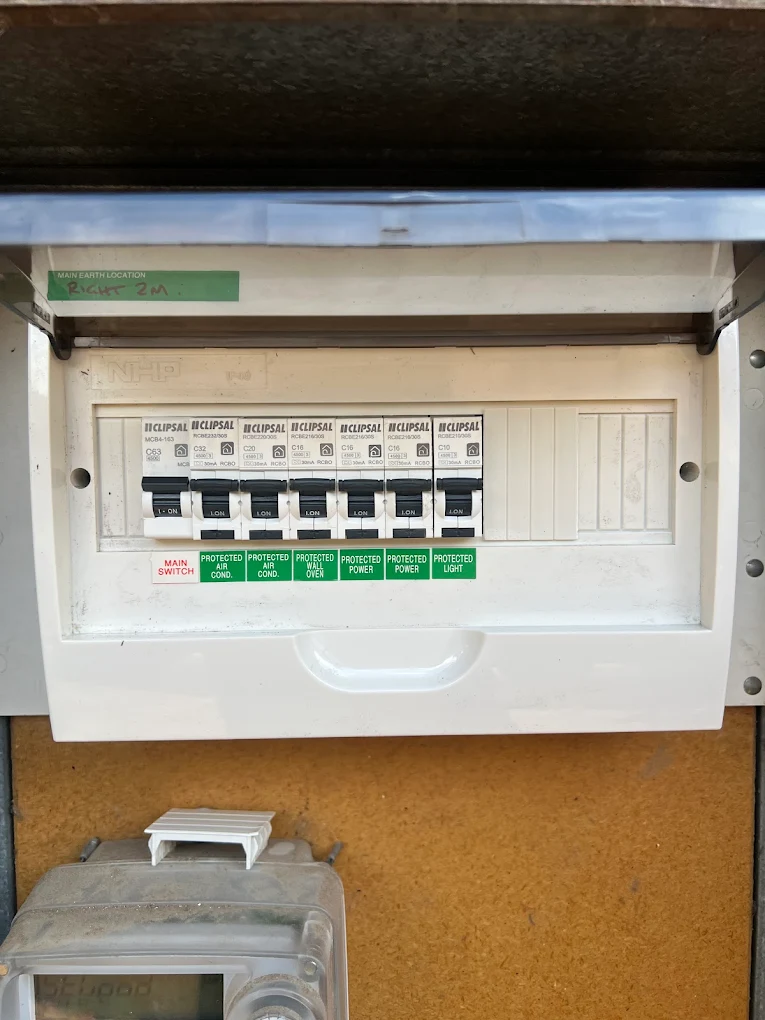
- Locate your switchboard. In most Melbourne homes, it’s mounted on an interior wall near the front of the house, in a garage, or in a utility area. Open the panel cover carefully.
- Identify the tripped breaker. A tripped breaker will sit in a middle position — not fully ‘on’ and not fully ‘off’. Some models have a small red or orange indicator window that appears when tripped.
- Switch it fully off first. Before resetting, push the breaker firmly to the ‘off’ position. This is a step many people skip, but it’s essential for a proper reset.
- Unplug appliances on that circuit. Head to the affected area and unplug or switch off any appliances that were running. This reduces the load before you restore power.
- Reset the breaker. Firmly push the breaker switch back to the ‘on’ position. You should feel a click and the switch should sit flush with the other breakers.
- Test the circuit gradually. Reconnect appliances one at a time to identify whether a specific device caused the overload.
- Monitor for repeat trips. If the breaker trips again immediately or within a short time, stop — do not keep resetting it. This signals a deeper problem that needs professional attention.
Understanding Your Switchboard and Australian Standards
Australian electrical installations are governed by AS/NZS 3000:2018, commonly known as the Wiring Rules. These standards specify how switchboards must be configured, labelled, and protected. If your switchboard lacks clear circuit labelling, that’s worth addressing — it makes fault-finding much safer and faster.
Modern switchboards in Melbourne also include residual current devices (RCDs) and arc fault detection devices (AFDDs). An RCD — sometimes called a safety switch — trips far more quickly than a standard circuit breaker and is designed to protect people from electric shock. If your safety switch has tripped rather than a circuit breaker, the reset process is the same, but the underlying cause is typically a fault in an appliance rather than an overload.
You can read more about electrical safety requirements through Energy Safe Victoria, the state’s electrical safety regulator.
Common Mistakes to Avoid When Resetting a Breaker
One of the most dangerous things you can do is repeatedly reset a breaker that keeps tripping. Each time a breaker trips, it’s doing exactly what it’s designed to do — protecting your home. Forcing it back on repeatedly can cause wiring to overheat and potentially start a fire inside your walls.
Another common mistake is assuming the problem is always the breaker itself. In reality, the breaker is usually fine — the issue lies with the circuit, the wiring, or an appliance. Replacing a breaker without investigating the root cause won’t solve anything and could make the situation worse.
Also avoid working inside the switchboard beyond simply flipping breaker switches. The busbars and incoming mains terminals inside a switchboard remain live even when individual breakers are off, and touching them can be fatal. That work is strictly for licensed electricians under Victorian law.
When to Call a Professional
There are clear situations where resetting the breaker yourself is not the right move. If your breaker trips repeatedly, if you notice scorch marks or a burning smell near the switchboard, if lights are flickering across multiple circuits, or if your switchboard is more than 25 years old, it’s time to call a licensed electrician.
The team at Goldworks Electrical services homes across Melbourne’s south-east, from Seaford to Langwarrin and beyond. Whether you’re dealing with a persistent tripping breaker, an overloaded circuit from a new ducted air conditioning installation in Langwarrin, or a switchboard that needs upgrading, a licensed electrician can diagnose the problem safely and correctly. Don’t risk your home or your family’s safety — contact Goldworks Electrical for an obligation-free assessment.
Conclusion
Understanding how to reset a circuit breaker in your house is genuinely useful knowledge for any Melbourne homeowner. The process itself is simple — identify the tripped breaker, switch it off, reduce the load, then switch it back on — but the key is recognising when the job goes beyond a basic reset.
Always treat a repeatedly tripping breaker as a warning sign, not an inconvenience. Your switchboard is your home’s first line of electrical defence. Keep it respected, keep it maintained, and when in doubt, reach out to the professionals at Goldworks Electrical’s blog or call them directly for expert advice tailored to your Melbourne home.
Frequently Asked Questions
Is it safe to reset a circuit breaker yourself?
Yes, resetting a tripped circuit breaker by flipping the switch is generally safe for a homeowner, provided your hands and surroundings are dry and you’re only touching the breaker switch itself. However, if the breaker trips again immediately, or if you notice any burning smell or visible damage, stop and call a licensed electrician rather than attempting further resets.
How do I know if my circuit breaker has tripped or if it’s a blown fuse?
Modern Melbourne homes typically have circuit breakers rather than fuses. A tripped breaker will sit in a middle or ‘off’ position and can be reset. Older homes may still have a fuse box with ceramic or glass fuses — if a fuse has blown, you’ll need to replace it. If you’re unsure which system your home has, a licensed electrician can inspect and advise.
Why does my circuit breaker keep tripping in the same room?
A breaker that repeatedly trips on the same circuit usually points to one of three issues: too many appliances drawing power at once (an overload), a faulty appliance causing a short circuit, or deteriorating wiring in that part of the house. Try unplugging appliances one at a time to isolate the cause. If the problem persists with nothing plugged in, you likely have a wiring fault that requires a licensed electrician.
Can I upgrade my switchboard myself in Victoria?
No. Under Victorian law and the Australian Wiring Rules (AS/NZS 3000:2018), all electrical work beyond basic tasks like changing a light globe must be carried out by a licensed electrician. Switchboard upgrades, circuit additions, and RCD installations all require a licensed professional and must be inspected and certified. Attempting this work yourself is illegal and extremely dangerous.