
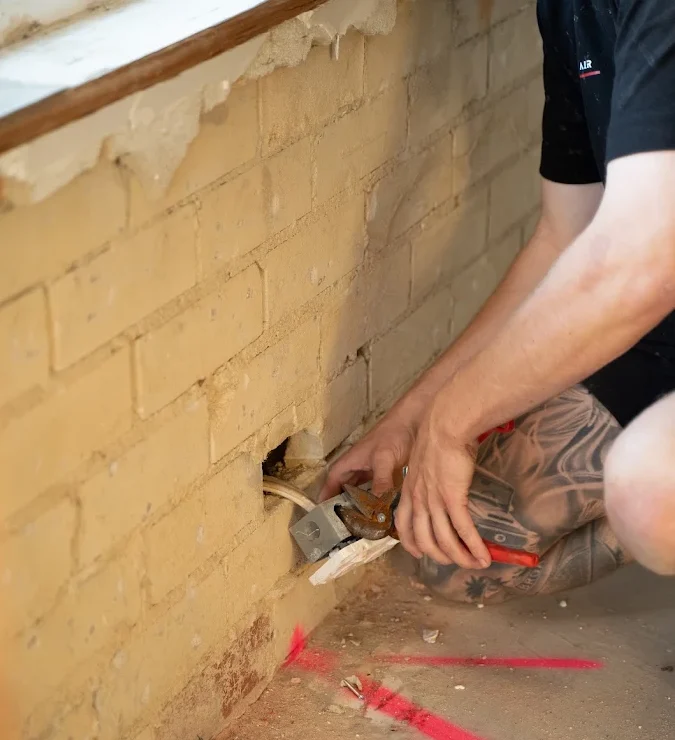
If you’re renovating in Melbourne, plan your power point installation before the plasterboard goes up. At that stage, running cable to a new outlet is a quick job. Once the walls are lined, plastered and painted, the same outlet means cutting into finished surfaces, patching and repainting.
The regrets people have after a renovation are usually small ones: a kitchen bench with nowhere to plug in the toaster, or a home office with one socket behind the desk. A licensed team offering electrical work across Melbourne can help you map this out early. This guide covers what to plan, what the rules say and where renovators usually slip up.
Why Renovation Is the Best Time for Power Point Installation
Because the walls are open. Electricians call this stage the rough-in. Cables are run through the wall frames and ceiling before the plasterboard goes on, and outlet positions are marked at the same time. Adding an extra power point here is mostly the cost of labour for the outlet itself, with no wall repairs on top.
Leave it until later, and the job gets harder. The electrician may need to chase cable through finished walls or take a longer route to avoid damage, and a patched wall rarely looks as good as an untouched one.
It affects everyone else on site too. Plasterers, painters and cabinet makers all work around the electrician’s timing, so a late change to your power point installation can hold up the trades behind it. If the house is older, ask the electrician to check the condition of the existing cable while the walls are open. You won’t get a cheaper chance to look.
How Many Power Points Does Each Room Need?
There’s no one-size-fits-all number, so it comes down to how you live. Count what you plug in today, then allow for what you’ll add over the next decade: more chargers, a second monitor, a robot vacuum, an e-bike.
Use this table as a starting point, not a rulebook:
| Room | What to plan for | Worth considering |
| Kitchen | Fridge, dishwasher, microwave, benchtop appliances | Outlets along every bench run, plus the island if you have one |
| Living room | TV, sound system, gaming, lamps | Outlets on both sides of the main wall and near seating |
| Main bedroom | Bedside lamps, phone charging | A double power point on each side of the bed |
| Kids’ rooms | Study, charging, night lights | Outlets by the desk, not just near the door |
| Home office | Computer, monitors, printer | More than you think, ideally with data points nearby |
| Laundry | Washer, dryer | Ask your electrician about outlet positions near water |
| Outdoors | Garden tools, BBQ, entertaining | Weather-rated outlets on a safety-switch-protected circuit |
More outlets means more convenience, not more electrical capacity. Each circuit still has a load limit, which is why a good power point installation plan looks at circuits as well as wall positions.
Kitchen Power Points: Where Renovations Go Wrong
Kitchens are where people run short first. You start with a fridge and a kettle, then the coffee machine, air fryer, blender and phone charger move in. Kitchen power points also sit alongside appliances like ovens, induction cooktops and dishwashers, which often need their own dedicated circuit instead of a standard outlet.
Decide these before the cabinet maker finalises the layout:
- Where each benchtop appliance will live, so outlets sit above the bench and not behind a tall unit
- Whether the island needs outlets
- Whether a pantry or coffee station needs power
- Where the fridge and dishwasher connect, so they can still be reached for servicing
Outlets near sinks have to keep set distances from water, so share your cabinet plans with the electrician instead of guessing. Sorting out kitchen power points on paper costs nothing, and it’s the most valuable part of any power point installation plan. Moving them after the splashback tiles go on costs a lot.
When a Double Power Point Makes Sense
A double power point is two sockets on one plate, and it’s the standard choice in most Australian homes. You get two plugs for one hole in the wall.
What it doesn’t give you is extra capacity. Both sockets share the same circuit, so a kettle and a toaster plugged into one double power point still count towards the same circuit limit as everything else on it. Overloading a busy circuit is a common reason for tripping.
Use a double power point where convenience matters: bedside tables, desks and TV walls. For heavy appliances, ask about a dedicated circuit. A single outlet on its own circuit is sometimes a better answer than another double on a crowded one, and it’s a decision worth making during power point installation, not after it.
Safety Switch Installation and Your Renovation
Short answer: yes, new power circuits should be protected by a safety switch. A safety switch, also called an RCD, cuts the power within milliseconds if it detects current leaking to earth, which is what prevents a serious shock. Energy Safe Victoria’s guidance says that when a switchboard is replaced, the wiring rules (AS/NZS 3000) require RCDs on all final sub-circuits. Since 29 March 2023, rental properties must also have them on all socket and lighting circuits. In practice, an electrician adding circuits during your renovation will fit RCD protection to them.
If your board still has ceramic fuses, or nothing on it has a test button, raise safety switch installation with your electrician before the walls close. An older board may also lack the space for extra circuits. In that case, a switchboard upgrade during the renovation is easier than retrofitting one later. Bundling safety switch installation with your power point installation also means fewer visits and less disruption.
Why You Can’t DIY Power Point Installation in Victoria
It’s illegal, and it can be deadly. Energy Safe Victoria says you must engage a registered electrical contractor for electrical installation work, and that doing it yourself breaks the law and puts lives at risk. That covers any power point installation, from adding a new outlet to swapping an old one.
When the job is finished, your electrician has to provide a Certificate of Electrical Safety, and you should receive your copy within 30 days. Energy Safe Victoria’s guidance on Certificates of Electrical Safety explains what the certificate covers and what to do if an electrician doesn’t provide one. Keep it with your renovation paperwork. It’s your record that the work was done legally and tested.
Common Power Point Installation Mistakes to Avoid
- Planning outlets after the cabinets are ordered. Joinery decides where outlets can go, so the two plans need to match.
- Relying on power boards. Too few outlets lead to stacked adapters and overloaded boards.
- Forgetting the outdoors. Entertaining areas, garages and sheds need weather-rated outlets on protected circuits.
- Ignoring future needs. An EV charger, home office or new air conditioner may need spare circuit capacity or conduit later.
- Choosing on price alone. Unlicensed work is illegal, and it leaves you with no certificate.
One thing never to postpone: if an outlet feels hot, buzzes, looks scorched or smells of burning, turn the power off at the switchboard, keep clear and phone an emergency electrician Melbourne homeowners can rely on. That isn’t a job for the renovation schedule.
How to Plan Your Power Point Installation Before the Electrician Arrives
Before your power point installation begins, a little preparation goes a long way:
- Mark furniture, TV, desk and bed positions on the floor plan.
- List what plugs in, room by room, including chargers.
- Share kitchen and joinery drawings with the electrician.
- Ask when the rough-in is scheduled and book a walkthrough before the walls close.
- Photograph the walls before they’re lined, showing the cable runs. You’ll be glad of them when you hang shelves or a TV bracket.
A marked-up plan and a walkthrough are the two cheapest ways to avoid rework.
Choosing Electricians Melbourne Renovators Can Trust
Start with the licence. Energy Safe Victoria keeps a public register where you can check a registered electrical contractor before you book. Then read the quote. It should say how many outlets are included, what type they are, whether switchboard or safety switch work is part of it, and whether the Certificate of Electrical Safety is included.
A good electrician will ask questions before quoting, such as wall type, access and what else is being renovated, and will coordinate timing with your builder. Goldworks Electrical works with builders, architects and homeowners on renovations across Melbourne, from rough-in through to final fit-off, so your power point installation fits in with the rest of the build.
Get Your Power Point Installation Right the First Time
The short version: decide where your outlets go before the walls close, plan kitchen power points around your cabinets, use a double power point for convenience while checking the circuit behind it, and always use a registered electrical contractor who provides a Certificate of Electrical Safety. That way your power point installation matches how you actually live in the house.
If you’re planning a renovation and want your power point installation done properly, contact Goldworks Electrical to talk through your plans and get a quote. It’s much easier to add outlets now than to open the walls again later.