
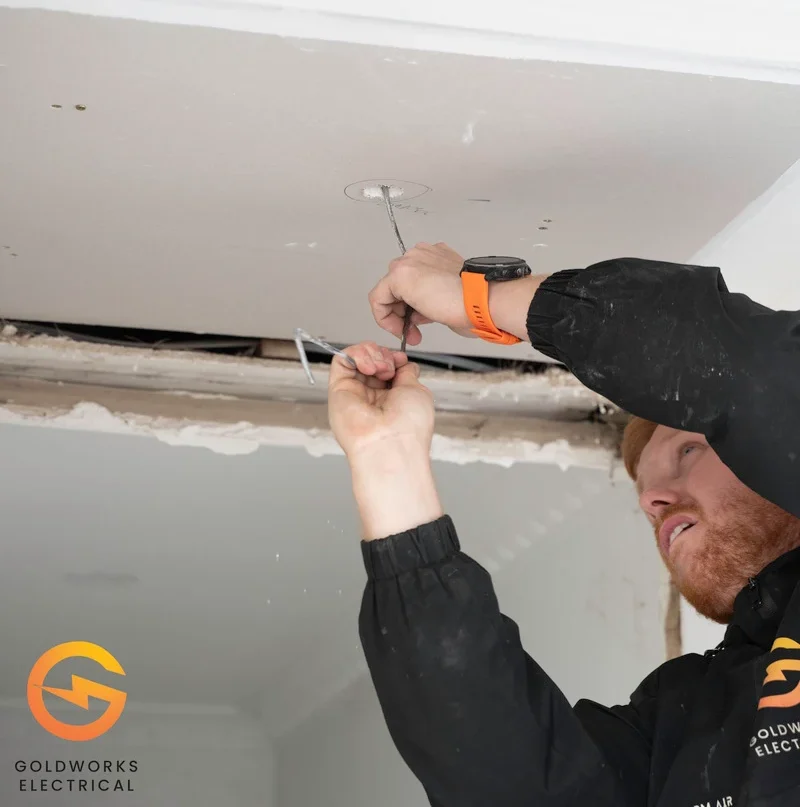
If you’re wondering whether you can fit your own smoke alarms or whether you need to call an electrician, the short answer is: it depends on the type of alarm. Battery-only units can usually be installed by a competent homeowner. Hardwired and interconnected systems legally require a licensed electrician. Getting this wrong isn’t just a compliance issue – it can mean your alarms don’t work the way they’re supposed to when it matters most.
Goldworks Electrical handles smoke alarm installation across Melbourne for homeowners, landlords, and property managers, and one of the most common questions we get asked is some version of “can I just do this myself?” It’s a fair question. Smoke alarms look simple. A round plastic unit, a couple of screws, done. But the reality of what’s involved – and what Victorian law actually requires – is a bit more layered than that.
Can You Legally Install Your Own Smoke Alarms in Melbourne?
Yes and no, depending on the alarm type.
Standalone, battery-powered smoke alarms that aren’t wired into your home’s electrical system can generally be installed by anyone. You’re not touching mains power, so there’s no licensing requirement standing in your way.
Hardwired smoke alarms are a different story. These connect directly to your home’s 240V circuit, and under Victorian law, any work on fixed electrical wiring must be carried out by a licensed electrician. This isn’t a grey area – the Victorian Government’s guidance on rental properties confirms that a hard-wired smoke alarm must be installed by a qualified electrician, while anyone can change a battery in an existing unit.
So if your home already has hardwired alarms and you just need a battery backup swapped, that’s fine to do yourself. If you’re adding new hardwired units, replacing an old wired system, or setting up interconnection between multiple alarms, that work needs a licensed electrician – no way around it.
What DIY Smoke Alarm Installation Actually Covers
To be fair to the DIY option, there are situations where it makes sense. If you’re renting and just need to freshen up an ageing battery unit, or you own a small unit with a single alarm and no hardwiring involved, doing it yourself is reasonably straightforward:
- Choose a photoelectric alarm – ionisation alarms don’t meet Victorian requirements
- Mount it on the ceiling, ideally in a hallway near bedrooms
- Test it once fitted using the test button
- Replace the battery (or the whole unit, if it’s a sealed 10-year type) on schedule
Where DIY starts to fall short is anywhere beyond this basic scenario – multiple bedrooms, multiple levels, older homes with no existing wiring, or any situation where the alarms need to be interconnected so they all sound together.
Why Hardwired and Interconnected Systems Need a Professional
This is where professional smoke alarm installation earns its keep, and it’s not just about ticking a legal box.
Interconnected smoke alarms are designed so that if one alarm detects smoke in, say, a garage or laundry, every alarm in the house sounds – including the one in a bedroom at the far end of the property where the initial alarm might never be heard. Wiring or configuring that system correctly takes an understanding of the property’s electrical layout that most homeowners simply don’t have.
Hardwired alarms also need to be tied into the right circuit, positioned correctly relative to walls and corners (airflow affects how quickly smoke reaches the sensor), and fitted with battery backup that actually engages during a power outage. Get the placement or wiring wrong, and you can end up with an alarm that’s technically installed but performs poorly – or worse, doesn’t go off at all.
Here’s a quick side-by-side to make the trade-offs clearer:
| Factor | DIY Installation | Professional Installation |
| Legal for hardwired alarms | No | Yes |
| Suitable alarm type | Battery-only | Hardwired, wireless, or battery |
| Interconnection | Not achievable safely | Fully configured and tested |
| Compliance documentation | None provided | Provided for landlords/records |
| Placement accuracy | Best-guess | Assessed against property layout |
| Warranty on workmanship | None | Typically included |
Cost Comparison: DIY vs Professional Smoke Alarm Installation
Cost is usually the deciding factor for people leaning toward DIY, so it’s worth being upfront about it. A single battery-powered smoke alarm from a hardware store might cost you $20 to $50, plus a few minutes of your time.
Professional smoke alarm installation costs more upfront because you’re paying for a licensed electrician’s time, correct placement, interconnection setup, and testing – not just the alarm itself.
The trade-off is worth weighing properly. A DIY battery alarm that’s poorly placed, not interconnected, or forgotten about for years is a false economy if it doesn’t function correctly when you need it. Landlords in particular should factor in that non-compliant alarms can create legal exposure that far outweighs the installation cost saved.
Common Mistakes People Make With DIY Smoke Alarms
A few issues come up again and again when we’re called out to fix or upgrade a DIY setup:
- Ionisation alarms still in use. These were common years ago but no longer meet Victorian requirements – photoelectric is now mandatory.
- Alarms placed too close to kitchens or bathrooms. This causes false alarms from steam or cooking, and people often end up disabling the alarm altogether out of frustration.
- No interconnection at all. A single alarm in a hallway does very little for someone asleep in a bedroom with the door closed.
- Batteries never replaced. Especially in rentals, where nobody feels responsible for maintenance until something goes wrong.
- Wrong number of alarms for the property. One alarm covering a two-storey home is a common shortfall we see during assessments.
When to Call a Licensed Electrician
As a general rule, get a professional involved if any of the following apply:
- Your home has (or needs) hardwired smoke alarms
- You want alarms interconnected across multiple rooms or levels
- You’re a landlord needing compliance documentation
- You’re renovating or building and smoke alarms are part of the electrical scope
- You’re not sure whether your current setup is even compliant
If none of that applies and you just need to swap a battery or replace a single standalone unit, DIY is a reasonable option.
Smoke Alarm Testing and Maintenance After Installation
Whichever route you take, installation isn’t the end of the job. Smoke alarms should be tested monthly using the test button, and batteries (where applicable) replaced annually unless they’re a sealed 10-year unit. Alarms themselves have a working life of around a decade – the manufacture date is usually printed on the back – and should be replaced entirely once they’re approaching that age, regardless of whether they still seem to work.
For rental properties, testing isn’t optional. Victorian tenancy law requires alarms to be tested within 30 days of a new tenancy starting, and landlords are responsible for keeping them in working order throughout the lease.
Conclusion
Deciding between DIY and professional smoke alarm installation really comes down to what type of alarm you need and what’s already in your property. A simple battery swap is fine to handle yourself, but anything involving hardwiring, interconnection, or rental compliance calls for a licensed electrician who can get the placement, wiring, and documentation right the first time.
If you’re not sure which category your situation falls into, or you’d rather just have it done properly without second-guessing the setup, get in touch with our team for a free quote. We’ll assess your property, recommend the right alarm type, and handle the installation and testing so you’re not left wondering whether it’s actually going to work when it counts.